






|
Melorheostosis Association Brochure |
|
© Copyright 2001—2007 Melorheostosis Association. All rights reserved. |

|
An international forum to unite patients with scientific and clinical scholars interested in finding the cause, treatment and cure for a rare bone disease |
|
RESEARCH is the key to solving the mysteries associated with melorheostosis.
HOPE for viable treatments is finally replacing the isolation once felt by all melorheostosis patients. |
|
Mission Statement The Melorheostosis Association is a not-for-profit organization dedicated to finding the cause, treatments and cure of melorheostosis. Our focus is on promoting greater awareness and understanding of this progressive disease and its manifestations through education, research, communication and advocacy efforts on behalf of those affected by it as well as those dedicated to alleviating it. |
|
Board of Directors Alice J. Albin, President Lydia Zepeda, Treasurer Kathleen Harper, Website Editor Donna DeLuca, Director Michelle Lundie, Director
Executive Director Lyn Pickel |
|
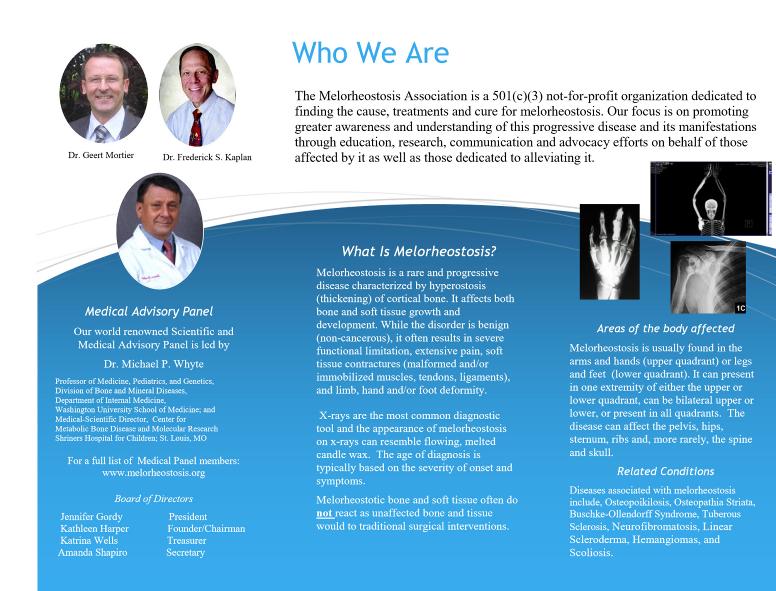
What is Melorheostosis? With an estimated incidence of 1:1,000,000, melorheostosis is a rare and progressive disease characterized by hyperostosis (thickening) of cortical bone. Melorheostosis affects both bone and soft tissue growth and development. While the disorder is benign, it often results in severe functional limitation, extensive pain, soft tissue contractures (malformed and/or immobilized muscles, tendons, ligaments), and limb, hand or foot deformity. The age of diagnosis is typically based on severity of onset and symptoms. How is melorheostosis diagnosed? X-Rays are the preferred diagnostic tool. X-rays often reveal a pattern of thickened bone (sclerotic bone lesions) that looks like dripping candle wax. What areas of the body are affected? Melorheostosis usually is found in the arms and hands (upper quadrant) or legs and feet (lower quadrant). It can present in one extremity of either the upper or lower quadrant, can be bilateral upper or lower, or evidence itself in all quadrants. The disease can also affect the pelvis, hips, sternum, ribs, and more rarely, the spine and skull. What is the cause of melorheostosis? The cause is currently unknown. It is believed the LEMD3 gene (which is critical to bone formation) may play a role in melorheostosis if the patient also has osteopoikilosis. However, this is not the whole story since the LEMD3 gene does not appear to be implicated in melorheostosis absent osteopoikilosis. Researchers are conducting further mutational analysis and looking at the role of certain “regulator” proteins in trying to discern a cause. With each discovery there is new insight, new possibilities, and we are one step closer to being able to identify the true cause of melorheostosis. One day this question will be answered! What is the treatment and long-term prognosis? Treatments are limited and often fraught with concern for patients and doctors alike. No treatment option has been found to be fully effective, and what may be helpful to one person may be ineffective or even detrimental to another. Treatment options include surgery, physical and occupational therapy, hydrotherapy, and medications to alter the bone remodeling process. |
|
As melorheostosis moves into a progressive state, pain management is one of the toughest challenges patients face. Medications available for pain include NSAIDs, steroids, narcotics, and occasionally, diphosphonates or biphosphonates. These medications are sometimes helpful in the early stages of the chronic progression, however, less so for the severely afflicted. Occasionally patients may resort to amputation in an attempt to alleviate the pain. Due to its rarity and the lack of effective treatment options, long-term prognosis cannot be accurately predicted. Symptoms · Irregular bone growth including cortical thickening and ‘candle wax’ appearance · Limb length inequalities · Joint swelling and fusion · Soft tissue abnormalities including tendon and ligament shortening, absent or abnormal muscles, calcification, contractures resulting in malformed or immobilized joints · Range of motion limitations · Pain and stiffness · Sensitivity to cold · Hyper-pigmentation of skin · Vascular abnormalities
Other Related Conditions Melorheostosis patients may present with any number of the following conditions: · Osteopoikilosis (spotted long bones) · Osteopathia Striata (streaked long bones) · Buschke-Ollendorf Syndrome (connective tissue nevi and Osteopoikilosis) · Tuberous Sclerosis · Neurofibromatosis · Linear Scleroderma · Desmoid tumors · Haemangiomas · Scoliosis |
|
Scientific/Medical Advisory Panel
Dr. Fred Kaplan, M.D., Panel Chair Isaac & Rose Nassau Professor of Orthopedic Molecular Medicine Chief, Division of Metabolic Bone Diseases & Molecular Medicine Department of Orthopaedic Surgery, University of Pennsylvania Dr. Francis H. Glorieux, M.D., Ph.D. Professor of Surgery, Pediatrics & Human Genetics McGill University Director of Research, Shriners Hospital for Children, Montreal Dr. Jill Helms, PH.D., D.D.S. Associate Professor, Plastic and Reconstructive Surgery Stanford University
Dr. Jeffrey C. King, M.D. Clinical Assistant Professor, Michigan State University Health Care Midwest, Hand & Elbow Surgery Dr. Peter Klein, M.D., Ph.D. Associate Professor of Medicine & Cell and Developmental Biology University of Pennsylvania Dr. Laura McCabe, Ph.D. Associate Professor, Department of Physiology Department of Radiology, College of Osteopathic Medicine Michigan State University Dr. Geert Mortier, M.D. Professor of Medicine, Department of Medical Genetics Ghent University Hospital, Belgium
Dr. Eileen M. Shore, Ph.D. Associate Professor of Orthopaedic Surgery & Genetics University of Pennsylvania
Dr. Ethel Siris, M.D. Director, Toni Stabile Center for the Prevention & Treatment of Osteoporosis, Columbia-Presbyterian Medical Center Metabolic Bone Diseases Program, Columbia University Dr. Andrew Weiland, M.D. Professor, Orthopaedic & Plastic Surgery Weill Medical College, Cornell University Dr. Michael Whyte, M.D. Medical-Scientific Director, Center for Metabolic Bone Disease & Molecular Research, Professor of Medicine, Pediatrics & Genetics Division of Bone & Mineral Diseases Washington Univ. School of Medicine Dr. Howard Worman, M.D. Associate Professor of Medicine Columbia University Dr. Michael Zasloff, M.D., Ph.D. Dean, Research & Translational Science Georgetown University Medical Center |
|
Address: 6611 Clayton Rd., Suite 209 St Louis, MO 63117
Email: lynbpickel@earthlink.net Phone: 1-314-727-0887 Time Zone: GMT-6 Website: www.melorheostosis.org
© Copyright 2006 Melorheostosis Association. All rights reserved. |
|
ABOUT YOUR GIFT... 100% of all gifts are used to support our mission: finding the cause, treatments and cure for melorheostosis.
Your gift will make a difference!
The Melorheostosis Association is a not-for-profit, tax exempt charity with IRS 501 (c)(3) status.
Please make your donation by: · Check payable to the Melorheostosis Association · Online with Paypal via our website (www.melorheostosis.org) |
|
For a PDF version of the brochure, suitable for printing, CLICK HERE |